
How Long Do ADU Approvals Take in Major U.S. Cities? (2026 Realistic Timeline Guide)
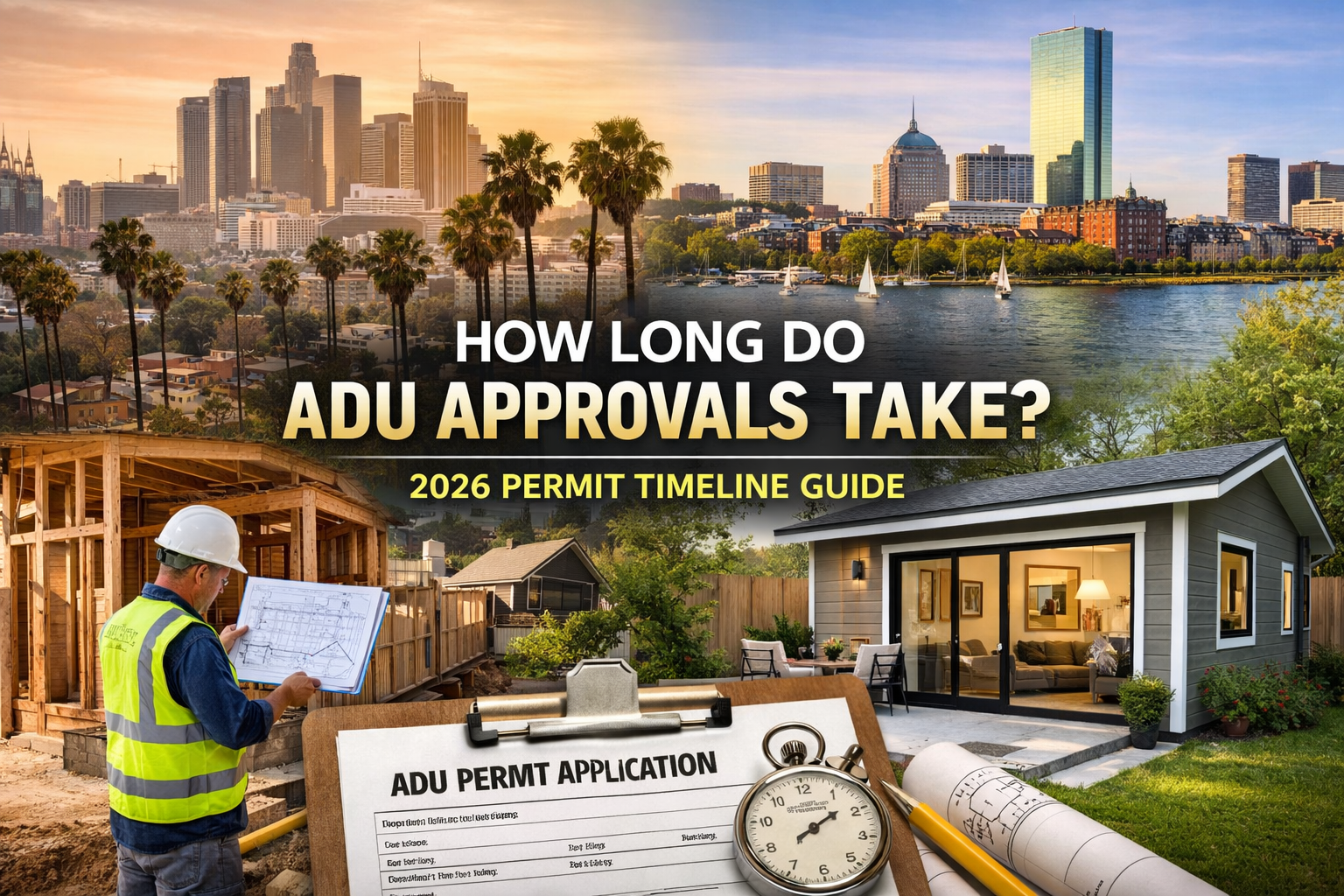
How Long Do ADU Approvals Take in Major U.S. Cities? (2026 Realistic Timeline Guide)
If you’re planning to build an ADU, one question comes up right away: How long will permits actually take? In most large U.S. cities, a realistic range is 2 to 12 months—and the difference usually comes down to your city’s workflow, your site conditions, and how clean your plans are when you submit.
Short answer: In most major U.S. cities, ADU approvals take 4–6 months, but can range from 2 to 12 months depending on zoning, corrections, and whether a variance is required.
Jump to your city:
Prefer to start with your lot first? Use the NEA address tool to quickly check zoning constraints before spending money on drawings: Check Your Lot.
And if you want the whole process in one place—what to do first, what comes next, and how NEA works— the best starting point is our walkthrough: Step by Step Guide.
The Honest Overview: Typical ADU Approval Timeline
In most big cities, an ADU permit isn’t “one approval.” It’s a sequence of checks that usually includes:
- Zoning verification
- Architectural plan review
- Structural review
- Utility review (water/sewer/electrical)
- Corrections & resubmissions
- Final permit issuance
Here are realistic planning ranges for major cities. Think of this as what you should budget for on your calendar—not the fastest-case scenario.
| City | Typical ADU Approval Time (2026) | What Usually Drives the Range |
|---|---|---|
| Los Angeles | 3–6 months | Correction cycles + utility coordination |
| San Diego | 2–4 months | Generally streamlined reviews |
| San Jose | 4–8 months | Higher plan-check load + resubmissions |
| Boston | 4–7 months | Overlays/historic rules + variance risk |
| Seattle | 3–6 months | Stormwater/drainage + site constraints |
| Austin | 2–5 months | Utilities + zoning confirmation timing |
| Portland | 3–6 months | Corrections + neighborhood/site factors |
Practical planning tip: if you want fewer surprises, assume 4–6 months of approvals unless you already know your city is unusually fast (or your scope is unusually complex).
Why ADU Approvals Take Time (Even in ADU-Friendly Cities)
Even in places that actively encourage ADUs, the city still has to confirm your project meets code. That typically means reviewers are checking for:
- Zoning compliance (use allowed, size, placement)
- Setbacks, lot coverage, and height
- Fire access (often the biggest “surprise”)
- Utilities (capacity + connection requirements)
- Energy code (insulation, systems, documentation)
- Stormwater/drainage (in some regions and site conditions)
What this means in plain English: approvals aren’t slow because reviewers want to slow you down. They’re slow because even small missing details trigger a correction round—and each round can add weeks.
City-by-City: What to Expect
Los Angeles, California
Los Angeles is one of the most ADU-active markets in the U.S. The workflow is relatively mature and digital submissions are standard—but you should still expect at least one correction round.
- Streamlined baseline process for standard projects
- Electronic plan submission and plan check are common
- Corrections are frequent, but often predictable
- Most standard ADUs avoid public hearings
Typical approval time: 3–6 months
If zoning is clear and your plan set is complete, many projects land closer to the 90–120 day range. Most “long” timelines come from resubmissions.
Boston, Massachusetts
Boston timelines depend heavily on where you are and whether your property falls into special zoning overlays or areas with additional review layers. The more site-specific the rules, the more time you should budget.
- Overlay zones can add extra review steps
- Historic considerations can slow approvals
- Utility coordination may take longer than homeowners expect
- Variances (if needed) can dramatically extend the process
Typical approval time: 4–7 months
If your project needs a variance or special exception, it can push into 8–10+ months depending on scheduling and revisions.
Seattle, Washington
Seattle has a favorable ADU environment, but local stormwater and drainage considerations can add steps depending on your neighborhood and site. Many projects move smoothly when the initial submission anticipates the city’s checklist.
- Generally supportive ADU policy framework
- Stormwater/drainage rules can add review items
- Lot coverage and access constraints matter
- Corrections still happen—speed depends on response time
Typical approval time: 3–6 months
Austin, Texas
Austin often moves faster than many coastal markets, especially for standard projects with clean drawings and straightforward zoning. Where people get stuck is usually utilities, access, or submitting before confirming zoning details.
- Digital plan review and permitting are common
- Fewer historic constraints in many areas
- Often shorter plan-check cycles for standard scopes
Typical approval time: 2–5 months
What Actually Causes ADU Permit Delays?
In major cities, most delays come from a few repeat issues—things that are frustrating, but preventable:
- Incomplete architectural plan sets (missing details reviewers expect)
- Missing structural calculations or stamped engineering
- Incorrect setbacks or site measurements
- Overlay zone rules not addressed up front
- Utility load or connection requirements underestimated
- Slow responses to correction notices
Fastest way to shorten your timeline: submit a plan set that answers the reviewer’s questions before they have to ask them. One clean submission often beats three “almost ready” submissions by months.
How to Speed Up Your ADU Approval (Practical Checklist)
- Confirm zoning first—before paying for full architectural drawings.
- Lock setbacks early—a setback surprise is the fastest path to redesign.
- Document utilities—capacity and connections are where timelines stretch.
- Submit complete structural + energy documentation from day one.
- Expect at least one correction round, and respond quickly.
- Align approvals with your build schedule so you’re not paying for downtime.
If you want a clear “do this, then that” roadmap for building through NEA, use: Step by Step Guide.
Best-Case vs Average vs Complex: What to Plan For
Best Case
- Zoning confirmed early
- Clean plan set submitted
- No variance required
- One minor correction round
Expected: 2–4 months
Average Case
- One structural clarification
- Utility questions
- Minor layout adjustment
Expected: 4–7 months
Complex Case
- Variance required
- Historic district or special review layer
- Major plan revisions
Expected: 8–12+ months
FAQ
How long does it take to get an ADU permit approved?
In most major U.S. cities, a realistic planning estimate is 4–6 months, with a broader range of 2–12 months depending on complexity and whether your project requires a variance.
Does a detached ADU take longer than a garage conversion?
Often yes. Detached ADUs typically trigger more structural and utility review requirements than conversions.
Can neighbors delay ADU approval?
In many cities, neighbors can’t “block” a code-compliant ADU. Timelines usually expand when a variance or exception is involved.
What’s the fastest way to avoid delays?
Confirm zoning early, submit a complete plan set (architectural, structural, and energy), and respond quickly to corrections. Most long delays come from resubmissions—not the first review.
Final Practical Answer
If you’re building an ADU in a major U.S. city in 2026, plan for: 4–6 months of permit time before construction begins.
If it finishes sooner, you’re ahead. If it takes longer, you weren’t caught off guard. Either way, you’ll make better decisions when your timeline is based on how the process actually works.